
The Move Multipliers Window
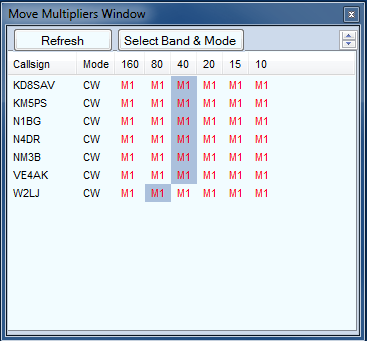
The Move Multipliers window is opened from the Window menu in the Entry Window. It lists the stations currently in the spot table, one row per callsign and mode, with a column for each band you have selected with Select Band & Mode.
Each band cell shows information as selected from the Display Options menu. With the default Multipliers choice, the cell shows whether working that station on that band and mode would be a new multiplier, based on your log and the contest’s multiplier rules (once per band, per mode, per band and mode, or per contest). M1 means one new multiplier. M2 means two or three new multipliers, for contests with more than one multiplier type. A blank cell means no new multiplier. The M1 and M2 text colors are the Mult and double Mult colors from your color settings.
The cell for each band a station was spotted on has a shaded background. If the same station and mode was spotted on several bands, each of the spotted band cells is shaded.
Click Refresh to rebuild the list. The window is not updated automatically when you log or delete a QSO or when a new spot arrives. It is rebuilt automatically when you open it, change the contest, change the Display Option, change the Type or Count Range, or change the bands or modes. Your own callsign and “CQ” spots are not listed. The window is blank for contests that have no multipliers. Use the font sizer buttons at the top right to change the font size. The window’s position, size and state are remembered between sessions.
Mouse clicks
- Left-click a shaded band cell: QSYs to the spot for that call on that band
- Left-click the Callsign or Mode cell: QSYs to the first shaded band for that row. Each subsequent click moves to the next band where that station was spotted
- Middle-click (wheel button) on a row: removes the row from this window only. The spot stays in the spot table and the row returns the next time you click Refresh
- SO1V: VFO A is set to the spot frequency. Shift+click does nothing
- SO2V: VFO A is set to the spot frequency. Shift+click sets VFO B to the spot frequency. If the target VFO is not the active one, the VFOs are swapped without changing frequency. Right-click sends the spot to the non-active VFO without making it active. Shift+right-click does nothing
- SO2R: The radio already on that band, if there is one, is set to the spot frequency. If neither radio is on that band, the inactive radio is set to the spot frequency and focus switches to that radio. Right-click does nothing
After any click, keyboard focus returns to the Entry Window.
Display Options menu
There is one menu item called Display Options, with two sub-items:
- Type – chooses what the band cells show. The choice is remembered between sessions:
- Multipliers (default): M1 or M2, as described above
- QSO Points: the points you would get for working the spotted station, or 0 if it would be a dupe. The same value appears in every band column of that row
- QSO Counts: the number of times you have already worked that callsign in that mode (this contest, only QSOs worth points). The count is shown in each band where you have worked the station, and “-” in the other bands
- Display Count Range (only when Type is set to QSO Points or QSO Counts): Stations whose value falls outside the range are hidden from the list. The default range is 0-6. Enter a range such as
3-5, or a single number such as5. Values run from 0 to 100. For example, a FOC-style contest might use4-5to list only stations worked four or five times
Select Band & Mode
The Select Band & Mode button opens the band and mode selection dialog. The choices are saved and the list refreshes when you close the dialog:
- Bands: 160 m through the microwave bands. If you have never made a selection, HF contests show 160-10 m, with 30, 17 and 12 m added for contests that allow the WARC bands (e.g. the DX contest type). Other contests show the VHF/UHF/microwave bands (the list depends on your continent)
- Modes: All, CW, Phone, RTTY, PSK, or Contest. Contest shows the modes allowed by the contest’s mode category (for example CW+Phone for Mixed, or CW only for CW). SSB, USB and LSB spots appear as PH, and all PSK variants appear as PSK